40 years of OLACDE’s Regional Program for Small Hydropower Power Plants

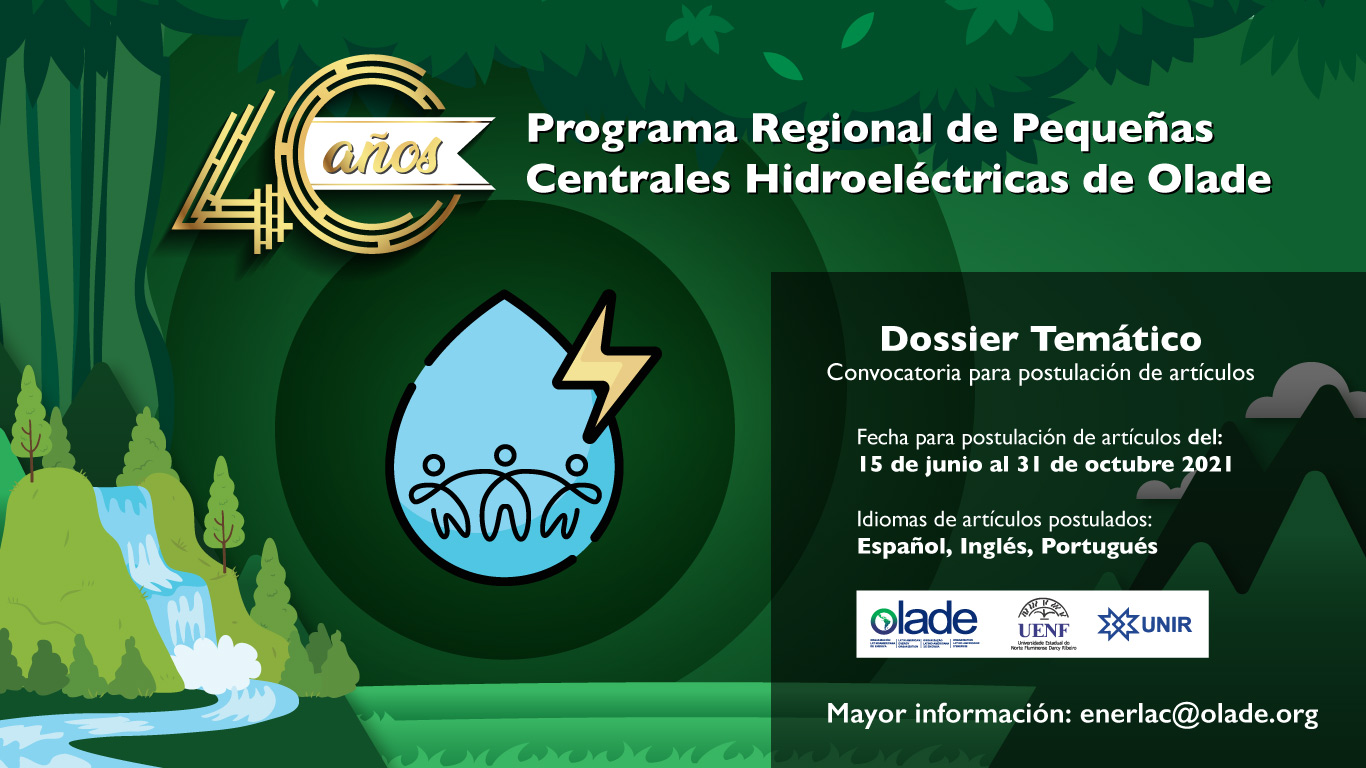
The Latin American and Caribbean Energy Organization (OLACDE) commemorates the 40th anniversary of the Regional Program for Small Hydroelectric Power Plants (PCH), “whose objective was to promote the massive implementation of small hydroelectric power plants in the region, as a partial response to the challenge of developing rural and remote areas by taking advantage of the existing water resources in Latin America and the Caribbean”.


During the years that the OLACDE Program was in operation, it published several studies in its ”Energy Bulletin” and ”Energy Journal” publications, mainly focused on the development of methodologies, technologies and equipment for SHP. Starting in 1984, the Organization began to compile information on the experiences of the countries of the region in the planning and construction of small hydroelectric power plants.


This information was published, between 1987 and 1988, in four editions called “Regional Document on National Experiences in Small Hydroelectric Power Plants.”


The first document explains that practically all of the 15 countries that were surveyed had or were in the process of establishing a National SHP Program, with a view to supporting the social and economic development of the rural sector, simplifying and reducing the cost of installing these plants.


Case studies from the following countries were published in subsequent issues of the document: Argentina, Brazil, Colombia, Costa Rica, Cuba, Ecuador, El Salvador, Guyana, Honduras, Jamaica, Mexico, Panama, Peru, Suriname and Venezuela.


Since the 1980s, small hydroelectric power plant projects have expanded around the world and the debate on the social, environmental and economic impacts generated by these projects has grown in the last two decades.


During this period, the debate has also grown in terms of cumulative and synergistic impacts, as well as environmental assessment, especially when several small hydroelectric power plants are concentrated in the same river basin (cascade effect).


In this context, OLACDE with the cooperation of researchers from the Universidade Estadual do Norte Fluminense Darcy Ribeiro (UENF) and the Universidade Federal de Rondonia (UNIR) of Brazil will carry out a dossier, whose central theme will be to understand the current situation of small hydropower plants in Latin America and the Caribbean, in the face of contemporary environmental conflicts. The aim is to provide an overview of the sector 40 years after the implementation of the Organization’s Regional SHP Program.


In this regard, the energy sector community and interested parties are invited to submit papers on this topic. Accepted papers will be published in a Thematic Dossier in the ENERLAC Journal in June 2022.


The call for papers will be made through the official communication channels of the participating institutions (social networks and website).


Guidelines:


Target audience: researchers, specialists, professionals and academic community of Latin America and the Caribbean.

Languages: Spanish, English and Portuguese.

First deadline for article submission: June 15 to October 31, 2021.

Publication of accepted articles: June 2022.

For more information contact: enerlac@OLACDE.org
Share this news

40 years of OLACDE’s Regional Program for Small Hydropower Power Plants

Newsletter summary

The Latin American and Caribbean Energy Organization (OLACDE) commemorates the 40th anniversary of the Regional Program for Small Hydroelectric Power Plants (PCH), “whose objective was to promote the massive implementation of small hydroelectric power plants in the region, as a partial response to the challenge of developing rural and remote areas by taking advantage of the existing water resources in Latin America and the Caribbean”. Communication Department and Institutional Relations gabriela.jarrin@OLACDE.org

Knowledge and Training

We promote advanced technical training programs that facilitate the exchange of experiences, as well as the development of the human and institutional capacities needed to support the energy transformations in our region.

Our academic offering includes executive programs, postgraduate diplomas, master’s degrees, and innovative initiatives focused on topics such as energy transition, conventional energy, renewable energy, e-mobility, and regional integration.

OLACDE creates a regional network focused on energy knowledge that connects governments, young professionals, academics, and sector experts to drive collaborative solutions through technical cooperation and talent development to address future energy and climate challenges.

Technical cooperation and financing

We strengthen South-South and triangular cooperation ties as drivers to accelerate energy transitions in Latin America and the Caribbean. OLACDE brings together efforts among governments, multilateral organizations, academic institutions, and the private sector to mobilize financing, technical capacities, and innovative solutions tailored to our regional reality.

We promote strategic initiatives aimed at directing resources toward projects focused on decarbonization, conventional energy, renewable energy, and energy justice, with the objective of establishing a more efficient, inclusive, and sustainable regional cooperation architecture.

Regional Energy Community

We are building a regional energy community with a global outlook that seeks to position Latin America and the Caribbean as a key player on the international stage. OLACDE strengthens its representation in major multilateral forums related to energy, trade, and climate by fostering strategic alliances and promoting international cooperation.

Through events such as Energy Week, together with new spaces for international dialogue, we promote a collective voice that helps attract financial investment and create new opportunities for sustainable development across our region.

Energy Transition and Strategic Projects

We drive an energy transition based on principles of sustainability, energy security, and social inclusion. OLACDE supports countries in adopting new technologies related to energy efficiency, energy storage, green hydrogen, electromobility, and grid digitalization to accelerate the sector’s decarbonization process.

Our approach also includes promoting strategic projects that strengthen energy resilience at the regional level, contributing to emission reductions while consolidating a cleaner and more competitive energy infrastructure. Initiatives such as OEMLAC position our region as a leading reference in climate innovation and sustainable energy transition.

Energy information and data

We develop regional platforms dedicated to energy information, technical analysis, and strategic data systems that strengthen both public and private decision-making in the sector. OLACDE promotes the digital transformation of the sector through the use of artificial intelligence, georeferencing, and advanced tools for regional energy analysis.

The integration of systems such as SieLAC, together with new regional platforms, allows for the consolidation of reliable and up-to-date technical information, facilitating modern, interoperable, and evidence-based energy planning.

Regional Energy Integration

We promote cooperation in the regional energy sector, focused on collaboration, infrastructure development, and regulatory harmonization, with the objective of strengthening energy security in Latin America and the Caribbean. OLACDE coordinates projects related to electrical interconnection, gas integration, and regional energy planning, seeking to create efficient and sustainable partnerships.

Through cooperation with the governments of our 27 member countries, regional blocs, multilateral institutions, and both public and private stakeholders, we drive strategic initiatives that promote regulatory harmonization and new energy exchange mechanisms, in order to enhance national capacities and accelerate an integrated energy transition at the regional level.

This site is registered on wpml.org as a development site. Switch to a production site key to remove this banner.