How to boost private companies and implement energy efficiency programs with local governments was discussed during dialogue

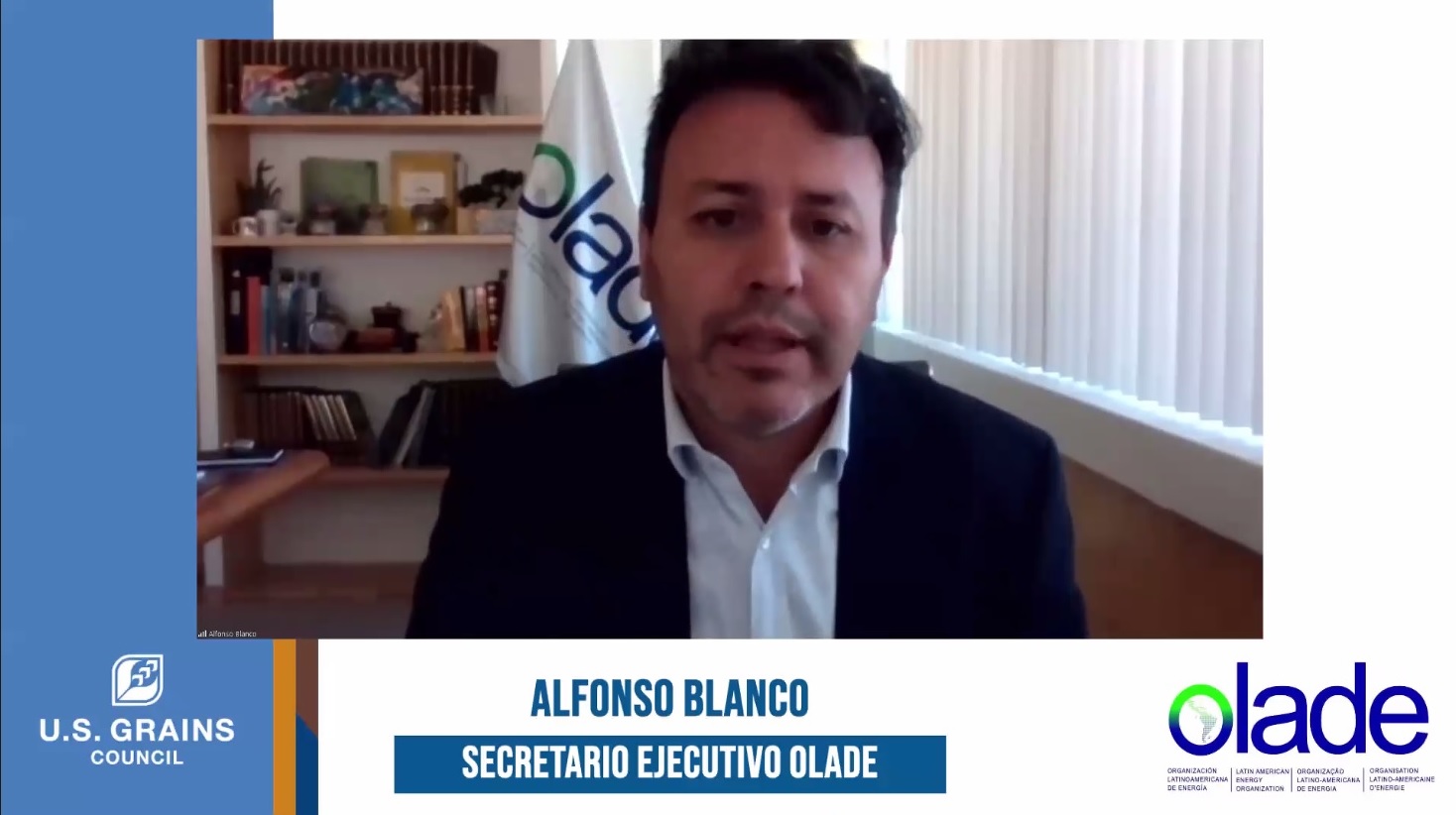
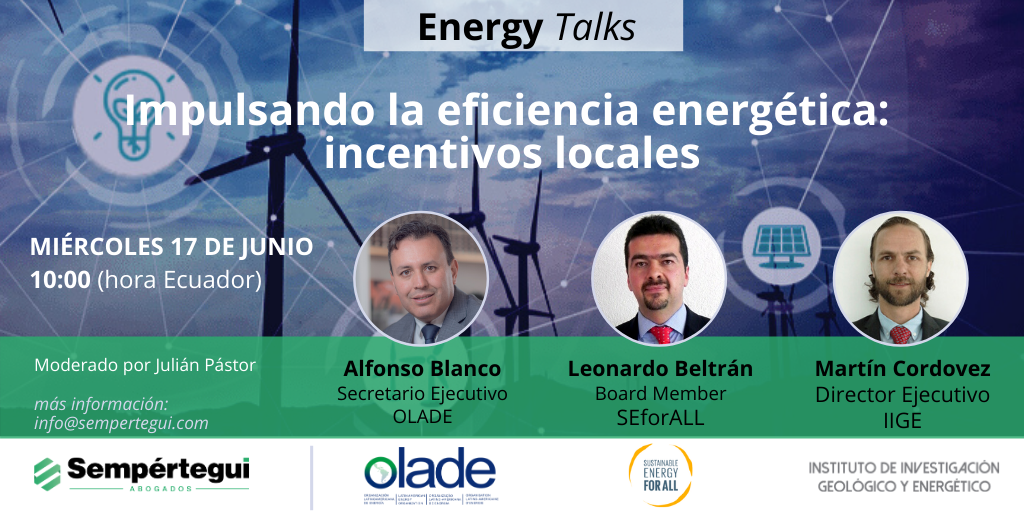
The Executive Secretary of The Latin American and Caribbean Energy Organization, Alfonso Blanco, during the dialogue “Boosting energy efficiency: local incentives”, organized by Sempértegui Abogados of Ecuador, mentioned some of the actions and barriers that exist around Energy Efficiency (EE) in the region, a space where the panel shared with the Executive Director of the Institute of Geological and Energy Research of Ecuador, Martín Cordovez and Leonardo Beltrán, member of the SEforALL board of directors.

This dialogue was started by the Executive Secretary, Alfonso Blanco, contextualizing Energy Efficiency (EE) as an instrument of energy policy that has the greatest potential in reducing greenhouse gases. “What is done in energy efficiency has a much greater impact on reducing greenhouse gases globally than any other measure that is implemented,” he said .

He pointed out that energy efficiency has a powerful content if it is analyzed from a global point of view, but at the level of local economies, EE contributes to the competitiveness of our productive sectors, to the best use of indigenous resources at the country level and also to energy security.

As well as working on best practices, at the level of final energy consumption by consumers. “EE has great positive externalities that are spread throughout the entire economy.”

With regard to the barriers that arise, the Executive Secretary explains that EE requires long-term policies and encouragement for their implementation, which is why it is required that those policies be maintained, which represents a great weakness in our region. This, since many countries have implemented energy efficiency measures, but have not been able to maintain EE momentum or leadership as a policy instrument, as there are changes in governments that have a different vision.

“We have not been able to consolidate EE as an instrument and a gear in the energy policy of our countries, with some exceptions at the regional level.”

In this context, he indicated that the main barriers that arise in the region are energy prices. “If we have a structure of internal energy prices, which are strongly distorted, we are not providing the necessary economic incentives for EE to be internalized by consumers.”

In his opinion, the Executive Secretary of OLACDE, Alfonso Blanco, points out that it is essential to internalize the important benefits of energy efficiency in the society in order to gradually overcome each one of the barriers that arise.

As an example, he explained the case of Paraguay that exports large amounts of energy to its neighboring countries and there is a conviction of the Paraguayan citizen that electrical energy is free for the country. Still, society does not internalize the benefits of saving energy and being more efficient in its use. This situation is reflected in many of the oil dependent countries, where, as there is certainty that the country has the natural resource, EE is not strictly necessary.

In Uruguay, the great result was obtained by deriving energy efficiency policies, from a supply crisis, since society as a whole had a perception that there were energy shortages and therefore had to take advantage of the best way that energy.

Therefore, this situation was opportune to enhance leadership by the country’s heads, as an example of this was that the President of the Republic was in charge of giving the message about the importance of energy efficiency.

Currently in Uruguay there are more than 50 energy service companies that provide services to the private sector for the development of EE projects.

In this context, the Secretary emphasized when saying that if we want to bring down market failures, we must designate a budget for the construction of these public policies.”

For his part, Leonardo Beltrán, member of the SEforALL board of directors, indicated that in Mexico around 30% of the household electric bill corresponds to lighting, a situation in which the Government took advantage of as a great opportunity to reduce the cost of the electric bill, exchanging conventional lighting technology for newer technologies, be they compact fluorescent or LED.

It did so through the design of a program to serve the residential sector and carry out this technology exchange offered by the Government, an action that was an appropriate incentive for both the residential consumer and the actor of public policy.

The Executive Director of the Geological and Energy Research Institute of Ecuador, Martín Cordovez, reported that in the country the National Energy Balance has been prepared with the OLACDE methodology, a product that is increasingly of interest to decision makers, because it allows to visualize and point to the sectors that have a greater potential in the generation of energy efficiency policies.


Department of Communication 

and Institutional Relations
gabriela.jarrin@OLACDE.org

Share this news

How to boost private companies and implement energy efficiency programs with local governments was discussed during dialogue

Newsletter summary

The Executive Secretary of The Latin American and Caribbean Energy Organization, Alfonso Blanco, during the dialogue “Boosting energy efficiency: local incentives”, organized by Sempértegui Abogados of Ecuador, mentioned some of the actions and barriers that exist around Energy Efficiency (EE) in the region, a space where the panel shared with the Executive Director of the […]

Knowledge and Training

We promote advanced technical training programs that facilitate the exchange of experiences, as well as the development of the human and institutional capacities needed to support the energy transformations in our region.

Our academic offering includes executive programs, postgraduate diplomas, master’s degrees, and innovative initiatives focused on topics such as energy transition, conventional energy, renewable energy, e-mobility, and regional integration.

OLACDE creates a regional network focused on energy knowledge that connects governments, young professionals, academics, and sector experts to drive collaborative solutions through technical cooperation and talent development to address future energy and climate challenges.

Technical cooperation and financing

We strengthen South-South and triangular cooperation ties as drivers to accelerate energy transitions in Latin America and the Caribbean. OLACDE brings together efforts among governments, multilateral organizations, academic institutions, and the private sector to mobilize financing, technical capacities, and innovative solutions tailored to our regional reality.

We promote strategic initiatives aimed at directing resources toward projects focused on decarbonization, conventional energy, renewable energy, and energy justice, with the objective of establishing a more efficient, inclusive, and sustainable regional cooperation architecture.

Regional Energy Community

We are building a regional energy community with a global outlook that seeks to position Latin America and the Caribbean as a key player on the international stage. OLACDE strengthens its representation in major multilateral forums related to energy, trade, and climate by fostering strategic alliances and promoting international cooperation.

Through events such as Energy Week, together with new spaces for international dialogue, we promote a collective voice that helps attract financial investment and create new opportunities for sustainable development across our region.

Energy Transition and Strategic Projects

We drive an energy transition based on principles of sustainability, energy security, and social inclusion. OLACDE supports countries in adopting new technologies related to energy efficiency, energy storage, green hydrogen, electromobility, and grid digitalization to accelerate the sector’s decarbonization process.

Our approach also includes promoting strategic projects that strengthen energy resilience at the regional level, contributing to emission reductions while consolidating a cleaner and more competitive energy infrastructure. Initiatives such as OEMLAC position our region as a leading reference in climate innovation and sustainable energy transition.

Energy information and data

We develop regional platforms dedicated to energy information, technical analysis, and strategic data systems that strengthen both public and private decision-making in the sector. OLACDE promotes the digital transformation of the sector through the use of artificial intelligence, georeferencing, and advanced tools for regional energy analysis.

The integration of systems such as SieLAC, together with new regional platforms, allows for the consolidation of reliable and up-to-date technical information, facilitating modern, interoperable, and evidence-based energy planning.

Regional Energy Integration

We promote cooperation in the regional energy sector, focused on collaboration, infrastructure development, and regulatory harmonization, with the objective of strengthening energy security in Latin America and the Caribbean. OLACDE coordinates projects related to electrical interconnection, gas integration, and regional energy planning, seeking to create efficient and sustainable partnerships.

Through cooperation with the governments of our 27 member countries, regional blocs, multilateral institutions, and both public and private stakeholders, we drive strategic initiatives that promote regulatory harmonization and new energy exchange mechanisms, in order to enhance national capacities and accelerate an integrated energy transition at the regional level.

This site is registered on wpml.org as a development site. Switch to a production site key to remove this banner.