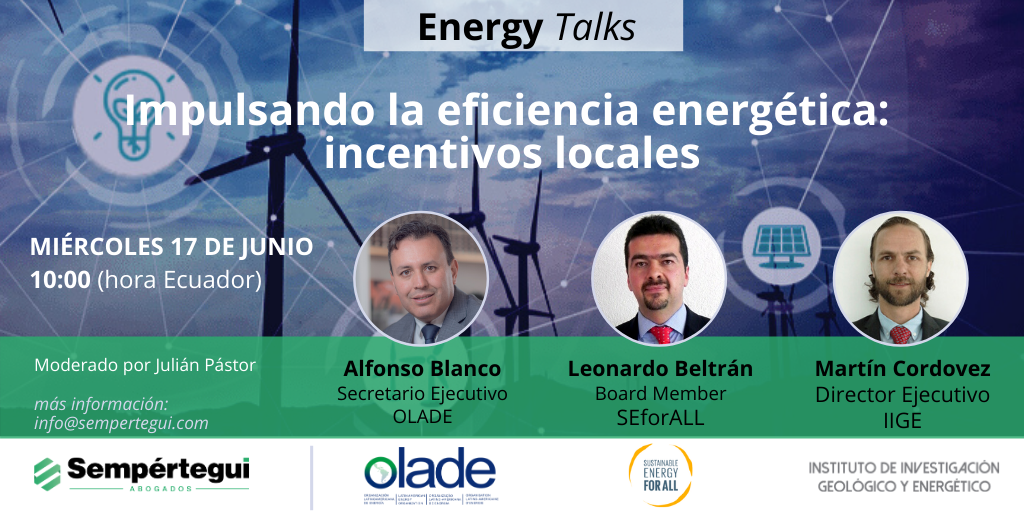
How to boost private companies and implement energy efficiency programs with local governments was discussed during dialogue

The Executive Secretary of The Latin American and Caribbean Energy Organization, Alfonso Blanco, during the dialogue “Boosting energy efficiency: local incentives”, organized by Sempértegui Abogados of Ecuador, mentioned some of the actions and barriers that exist around Energy Efficiency (EE) in the region, a space where the panel shared with the Executive Director of the Institute of Geological and Energy Research of Ecuador, Martín Cordovez and Leonardo Beltrán, member of the SEforALL board of directors.

This dialogue was started by the Executive Secretary, Alfonso Blanco, contextualizing Energy Efficiency (EE) as an instrument of energy policy that has the greatest potential in reducing greenhouse gases. “What is done in energy efficiency has a much greater impact on reducing greenhouse gases globally than any other measure that is implemented,” he said .

He pointed out that energy efficiency has a powerful content if it is analyzed from a global point of view, but at the level of local economies, EE contributes to the competitiveness of our productive sectors, to the best use of indigenous resources at the country level and also to energy security.

As well as working on best practices, at the level of final energy consumption by consumers. “EE has great positive externalities that are spread throughout the entire economy.”

With regard to the barriers that arise, the Executive Secretary explains that EE requires long-term policies and encouragement for their implementation, which is why it is required that those policies be maintained, which represents a great weakness in our region. This, since many countries have implemented energy efficiency measures, but have not been able to maintain EE momentum or leadership as a policy instrument, as there are changes in governments that have a different vision.

“We have not been able to consolidate EE as an instrument and a gear in the energy policy of our countries, with some exceptions at the regional level.”

In this context, he indicated that the main barriers that arise in the region are energy prices. “If we have a structure of internal energy prices, which are strongly distorted, we are not providing the necessary economic incentives for EE to be internalized by consumers.”

In his opinion, the Executive Secretary of OLACDE, Alfonso Blanco, points out that it is essential to internalize the important benefits of energy efficiency in the society in order to gradually overcome each one of the barriers that arise.

As an example, he explained the case of Paraguay that exports large amounts of energy to its neighboring countries and there is a conviction of the Paraguayan citizen that electrical energy is free for the country. Still, society does not internalize the benefits of saving energy and being more efficient in its use. This situation is reflected in many of the oil dependent countries, where, as there is certainty that the country has the natural resource, EE is not strictly necessary.

In Uruguay, the great result was obtained by deriving energy efficiency policies, from a supply crisis, since society as a whole had a perception that there were energy shortages and therefore had to take advantage of the best way that energy.

Therefore, this situation was opportune to enhance leadership by the country’s heads, as an example of this was that the President of the Republic was in charge of giving the message about the importance of energy efficiency.

Currently in Uruguay there are more than 50 energy service companies that provide services to the private sector for the development of EE projects.

In this context, the Secretary emphasized when saying that if we want to bring down market failures, we must designate a budget for the construction of these public policies.”

For his part, Leonardo Beltrán, member of the SEforALL board of directors, indicated that in Mexico around 30% of the household electric bill corresponds to lighting, a situation in which the Government took advantage of as a great opportunity to reduce the cost of the electric bill, exchanging conventional lighting technology for newer technologies, be they compact fluorescent or LED.

It did so through the design of a program to serve the residential sector and carry out this technology exchange offered by the Government, an action that was an appropriate incentive for both the residential consumer and the actor of public policy.

The Executive Director of the Geological and Energy Research Institute of Ecuador, Martín Cordovez, reported that in the country the National Energy Balance has been prepared with the OLACDE methodology, a product that is increasingly of interest to decision makers, because it allows to visualize and point to the sectors that have a greater potential in the generation of energy efficiency policies.


Department of Communication 

and Institutional Relations
gabriela.jarrin@OLACDE.org

Comparte esta noticia

How to boost private companies and implement energy efficiency programs with local governments was discussed during dialogue

Resumen del boletín

The Executive Secretary of The Latin American and Caribbean Energy Organization, Alfonso Blanco, during the dialogue “Boosting energy efficiency: local incentives”, organized by Sempértegui Abogados of Ecuador, mentioned some of the actions and barriers that exist around Energy Efficiency (EE) in the region, a space where the panel shared with the Executive Director of the […]

Conocimiento y capacitación

Fomentamos programas formativos técnicos avanzados que facilitan el intercambio de experiencias, así como el desarrollo de capacidades humanas e institucionales necesarias para respaldar las transformaciones energéticas en nuestra región.

Nuestra oferta académica incluye programas ejecutivos, diplomados, maestrías e iniciativas innovadoras centradas en temas como transición energética, energías convencionales, energías renovables, electromovilidad e integración regional.

OLACDE crea una red regional enfocada en el conocimiento energético que conecta a gobiernos, jóvenes profesionales, académicos y expertos del sector para impulsar soluciones colaborativas mediante la cooperación técnica y la formación de talento para enfrentar los desafíos energéticos y climáticos futuros.

Cooperación técnica y financiamiento

Fortalecemos los vínculos de cooperación Sur-Sur y triangular como impulsores para acelerar las transiciones energéticas en América Latina y el Caribe. OLACDE integra esfuerzos entre gobiernos, organismos multilaterales, instituciones académicas y el sector privado para movilizar financiamiento, capacidades técnicas y soluciones innovadoras adaptadas a nuestra realidad regional.

Promovemos iniciativas estratégicas dirigidas a orientar recursos hacia proyectos enfocados en descarbonización, energías convencionales, energías renovables y justicia energética, con el objetivo de establecer una arquitectura de cooperación más eficiente, inclusiva y sostenible a nivel regional.

Comunidad energética regional

Establecemos una comunidad energética regional con proyección global que busca situar a América Latina y el Caribe como un actor relevante dentro del contexto internacional. OLACDE refuerza su representación ante los principales foros multilaterales relacionados con energía, comercio y clima al fomentar alianzas estratégicas e impulsar la colaboración internacional. 

A través de eventos como la Semana de la Energía, junto con nuevos espacios para el diálogo internacional, promovemos una voz colectiva que permita atraer inversiones financieras, así como nuevas oportunidades para un desarrollo sostenible dentro de nuestra región.

Transición energética y proyectos estratégicos

Impulsamos una transición energética sustentada por principios de sostenibilidad, seguridad energética e inclusión social. OLACDE apoya a los países en la adopción de nuevas tecnologías relacionadas con eficiencia energética, almacenamiento de energía, hidrógeno verde, electromovilidad y digitalización de redes para acelerar el proceso de descarbonización del sector.

Nuestro enfoque también incluye promover proyectos estratégicos que fortalezcan la resiliencia energética a nivel regional, lo que contribuye a reducir emisiones mientras se consolida una infraestructura energética más limpia y competitiva. Iniciativas tales como OEMLAC posicionan a nuestra región como un referente destacado en innovación climática y transición energética sostenible.

Información y datos energéticos

Desarrollamos plataformas regionales dedicadas a la información sobre energía, análisis técnico y sistemas de datos estratégicos que refuerzan la toma de decisiones tanto públicas como privadas en el sector. OLACDE promueve la transformación digital del sector mediante el uso de inteligencia artificial, georreferenciación y herramientas avanzadas para el análisis energético regional.


La integración de sistemas como SieLAC, junto con nuevas plataformas regionales, permite consolidar información técnica confiable y actualizada, facilitando una planificación energética moderna, interoperable y basada en evidencia.

Integración energética regional

Fomentamos la cooperación en el ámbito energético regional, centrada en la colaboración, el desarrollo de infraestructuras y la armonización regulatoria, con el objetivo de reforzar la seguridad energética en América Latina y el Caribe. OLACDE coordina proyectos relacionados con la interconexión eléctrica, la integración del gas y la planificación energética regional, buscando crear alianzas eficientes y sostenibles. 


Mediante la cooperación con los gobiernos de nuestros 27 países miembros, bloques regionales, instituciones multilaterales y actores tanto públicos como privados, impulsamos iniciativas estratégicas que promueven la armonización normativa y nuevos mecanismos de intercambio energético, con el fin de potenciar las capacidades nacionales y acelerar una transición energética integrada a nivel regional.

This site is registered on wpml.org as a development site. Switch to a production site key to remove this banner.