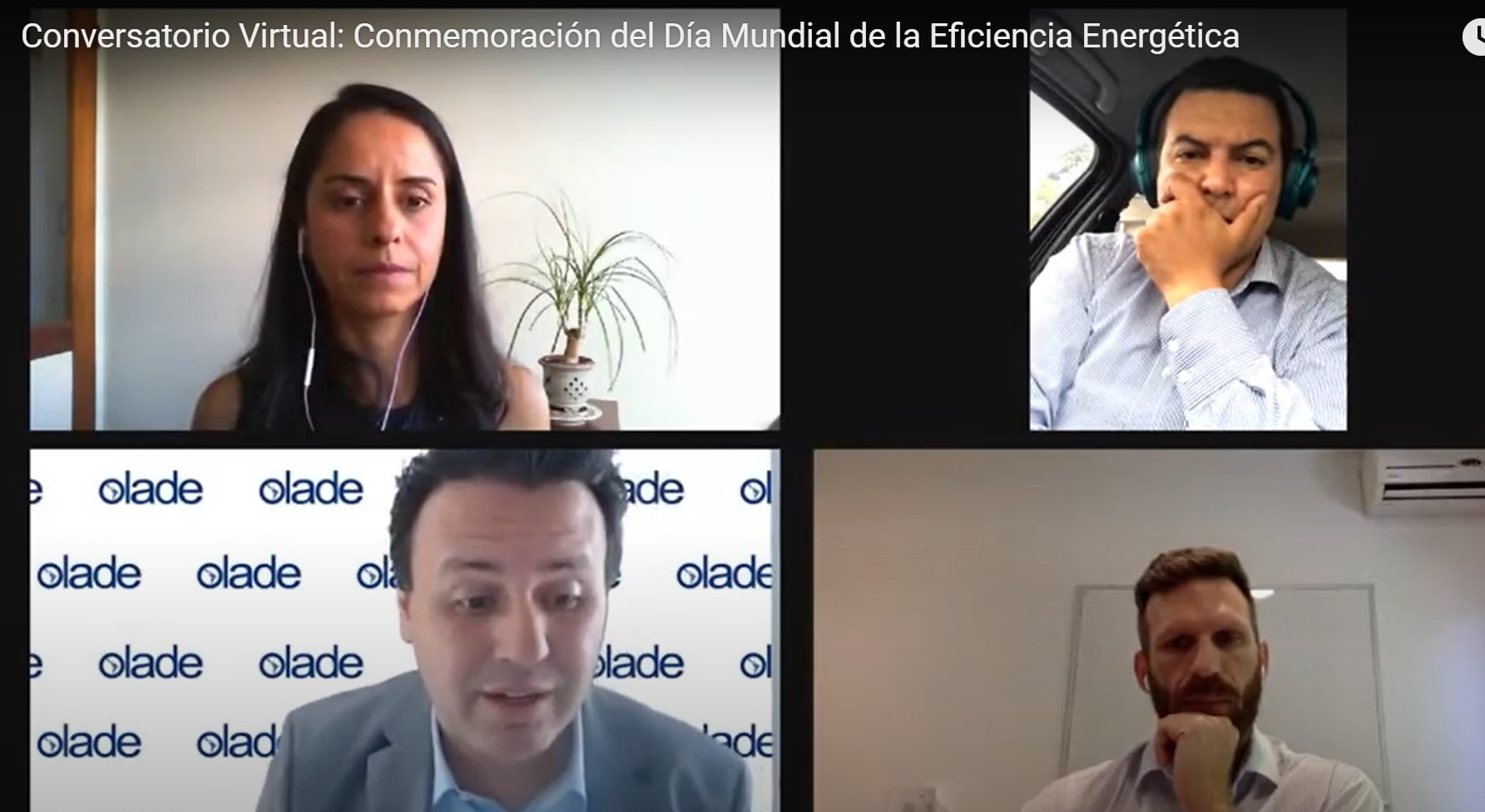
In commemoration of the World Energy Efficiency Day (EE), celebrated on March 5, The Latin American and Caribbean Energy Organization (OLACDE), through the Executive Secretary, Alfonso Blanco, participated in the Dialogue “The path towards energy efficiency in Latin America: challenges and opportunities for 2021”, event organized by the Spanish Agency for International Development Cooperation (AECID) and the French Agency for Development (AFD), together with the program funded by the European Union EUROCLIMA+.
The Executive Secretary of OLACDE, Alfonso Blanco, during his participation, on the challenges and opportunities in the Latin American region, highlighted that “energy efficiency has the real capacity to effectively influence world energy demand, and even more when there are economic rearrangements at a global level and many emerging economies have joined the demand scenario”.
In this same context, the Executive Secretary indicated that while in developed countries energy efficiency is directly linked to actions to mitigate climate change, for emerging countries EE acquires a particular meaning that includes other additional high-weight motivators such as: reduces dependence on fossil fuels, imports, conservation of scarce resources, improves the competitiveness of productive sectors, provides a better allocation of resources for infrastructure, contributes to solving problems of security and access to energy, among others.
Regarding the issue of why it is necessary to legislate on energy efficiency, he pointed out that the reason is that the identified market barriers, that make it impossible to take advantage of the potential for improvement in the use of energy resources and translate into a loss of social welfare, must be demolished.
On the other hand, he mentioned that there is a “positive spill over the economy as a whole” that translates into growth, improved competitiveness, reduced emissions, improved social equality and the development of new capabilities and business opportunities.
Another aspect presented by the Executive Secretary was the approach to EE as a right and an obligation, transferring the benefits to consumers in terms of quality, safety, stability, opportunity and price. And provide the availability of information to consumers so that they have a free choice in terms of their practices and habits at the level of energy consumption.
“Energy has a direct impact on the environment and must be supplied and used in such a way that we can minimize the generation of negative externalities. These are powers that the State has and for this reason it is justified to act within a legal framework”. OLACDE’s Executive Secretary, Alfonso Blanco.
Regarding the barriers for EE, the Secretary detailed some of them: economic, technical, technological, capacities, regulatory, political, institutional, cultural, information and financing.
Additionally, he explained that a correct strategy to establish EE as a long-term policy starts from the need to go through a process of “maturation”. “Paths prior to legislation must necessarily be traveled,” he emphasized.
“We have to generate long-term State policies for EE, with a vision in which EE is part of the energy policy and a development model at the country level” Executive Secretary of OLACDE, Alfonso Blanco.
This Discussion had three thematic axes: 1. Regulatory framework and legislation for energy efficiency, 2. Challenges and opportunities of the Latin American region and 3. Building hand in hand with the country context: success stories in Argentina and Colombia.
This activity was coordinated by the Spanish Agency for International Development Cooperation (AECID) and the French Agency for Development (AFD) together with the program funded by the European Union EUROCLIMA+.
This meeting also had the participation of: Mr. Juan Enrique Yuste, Head of Programs at AECID, Mr. Sebastián Jure, Deputy Director of the AgenciaSE of Chile, Mr. Helmer Acevedo, Technical Advisor on Energy Efficiency, SETEC in Colombia, Ricardo Bertolino , Executive Director of the Argentine Network of Municipalities against Climate Change, Andrés Amell, Professor at the University of Antioquia and Farid Chejne, Professor at the National University of Colombia.
March 5 World Energy Efficiency Day
In 1998, the First International Conference on Energy Efficiency took place in Austria, a space where the energy crisis, energy efficiency and possible solutions were discussed.
Within the framework of this conference, March 5 was designated as World Energy Efficiency Day, a day to remind the world’s population of the importance of efficient energy use.
Energy efficiency is conceived as an essential policy to stop climate change and is included in the United Nations Sustainable Development Goals (SDGs) and in the 2030 Agenda, which aims to double the rate of efficiency in the use of energy in the next decade.
Energy efficiency is not about giving up quality of life, but about obtaining the same energy goods and services using fewer resources, improving processes, promoting recycling, the use of less polluting products and smart consumption.
In this link you can follow the recorded transmission of the full webinar: https://www.youtube.com/watch?v=cpgX6yhKkh0
Communication Department
and Institutional Relations
gabriela.jarrin@OLACDE.org