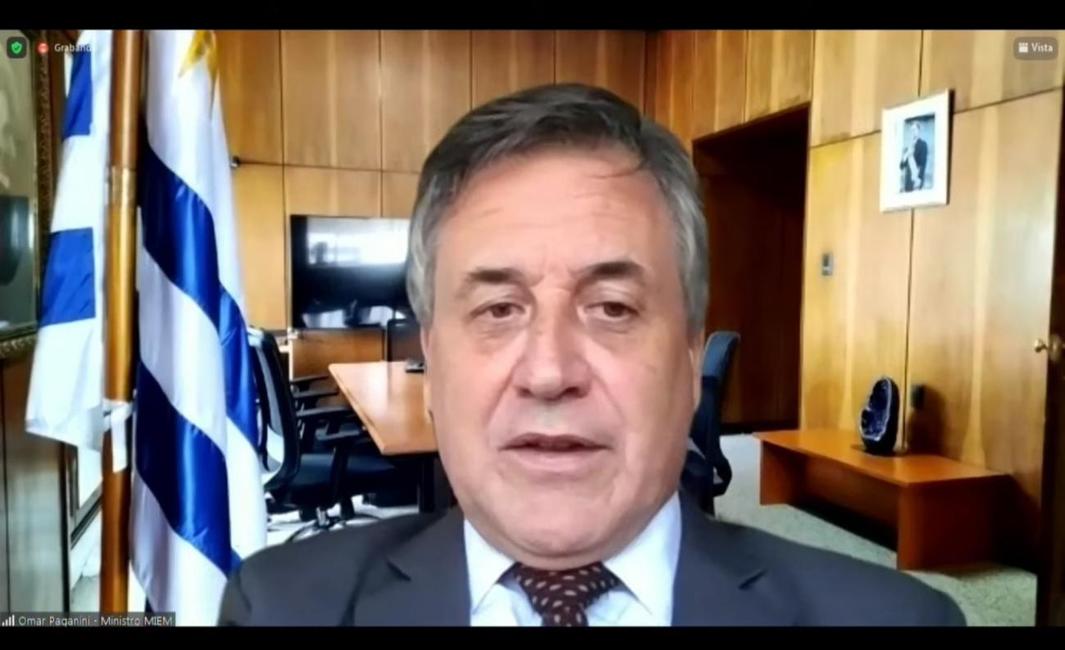
The Ministry of Industry, Energy and Mining of Uruguay (MIEM) and The Latin American and Caribbean Energy Organization (OLACDE) held the I International Forum on Electric Mobility under the slogan Decarbonizing transportation. At the meeting, which took place on April 15, 2021, Minister Omar Paganini summarized the plans with which Uruguay is moving towards the second energy transition.
During the opening of the event, Minister Omar Paganini thanked OLACDE for its support and announced that incentives to expand the electric fleet (in public transport and small vehicles) will continue in the country, while UTE (Administración Nacional de Usinas y Trasmisiones Eléctricas) will install 152 new chargers in public spaces, among other measures.
The minister recalled that Uruguay has strengths in terms of power generation. He expressed his pride for the first energy transformation that has obtained these achievements and that has placed the country in a position of international recognition. For example, the country ranks second in the world in wind power generation, only behind Denmark, he said.
However, the Secretary of State emphasized that it is now time to assume a second energy transformation that bets on decarbonization. “Today, 37% of Uruguay’s energy matrix comes from fossil fuels and transportation represents two thirds of it,” he said.
The minister also stressed the importance of inter-institutional work to encourage the transformation of the public fleet, through subsidies that have allowed the incorporation of dozens of electric buses in Montevideo. He affirmed that work will continue in this direction, as well as in the incorporation of electric cabs.
He also informed that Uruguay is one of the four countries in the world that will receive funding from the United Nations Joint Fund for Sustainable Development Goals (SDGs). With the $10 million non-reimbursable dollars obtained, bank financing will be leveraged for public-private projects in the area of decarbonization, environmental sustainability and circular economy. This includes mobility.
Likewise, Uruguay’s Minister of Environment, Adrián Peña, who also participated in the opening, highlighted that Uruguay is working on the development of environmental policies thanks to the new institutional framework created with the Ministry of Environment.
He explained that the country had advanced in important regulations, as well as in the National Policy on Climate Change and in the compliances derived from the Paris Agreement.
He announced that in 2022 a Second Nationally Determined Contribution will be made, more ambitious than the first and that the government is approaching the long-term climate strategy. To this end, the Ministry of Environment and MIEM are currently working on the creation of a national adaptation plan for the energy sector.
“In this framework, electric mobility is a key factor and is included in some of the unconditional commitments arising from the Paris Agreement” mentioned Uruguay’s Minister of Environment, Adrián Peña.
For his part, OLACDE’s executive secretary, Alfonso Blanco, thanked the MIEM for the incorporation of the forum “which allows the incorporation of regional knowledge and policies” and congratulated Uruguay for integrating state energy policies with environmental policies, through a collaborative work that is not common in the region.
He added that OLACDE promotes these national development practices throughout the region, taking into account that, on average, transportation represents 38% of final energy consumption in the region.
OLACDE’s Executive Secretary emphasized that Uruguay is capable of integrating state energy and environmental policies.
For his part, the National Energy Director of Uruguay, Fitzgerald Cantero, assured that the objective is to continue in this line of exchange, through new forums and collective instances.
He stressed the relevance of learning about international experiences and said that it is necessary for both Uruguay and the region to generate more infrastructure to promote electric mobility, for example, through a regional network of chargers.
Cantero said that conditions must be provided so that families and institutions can freely choose how they wish to move around. In addition, he added that public organizations must ensure that the public and family transportation network is more efficient.
The I International Electric Mobility Forum also featured a presentation by Christopher Zegras, from Mobility and Urbanism at the Massachusetts Institute of Technology (MIT), who gave a presentation in which he analyzed the current reality of mobility, which includes aspects such as digital transformation and automation.
He showed several international studies and stated that a change of this magnitude requires urban and strategic planning, since “building transportation is building cities”. He clarified that the process must be careful and that it is costly and difficult to reverse.