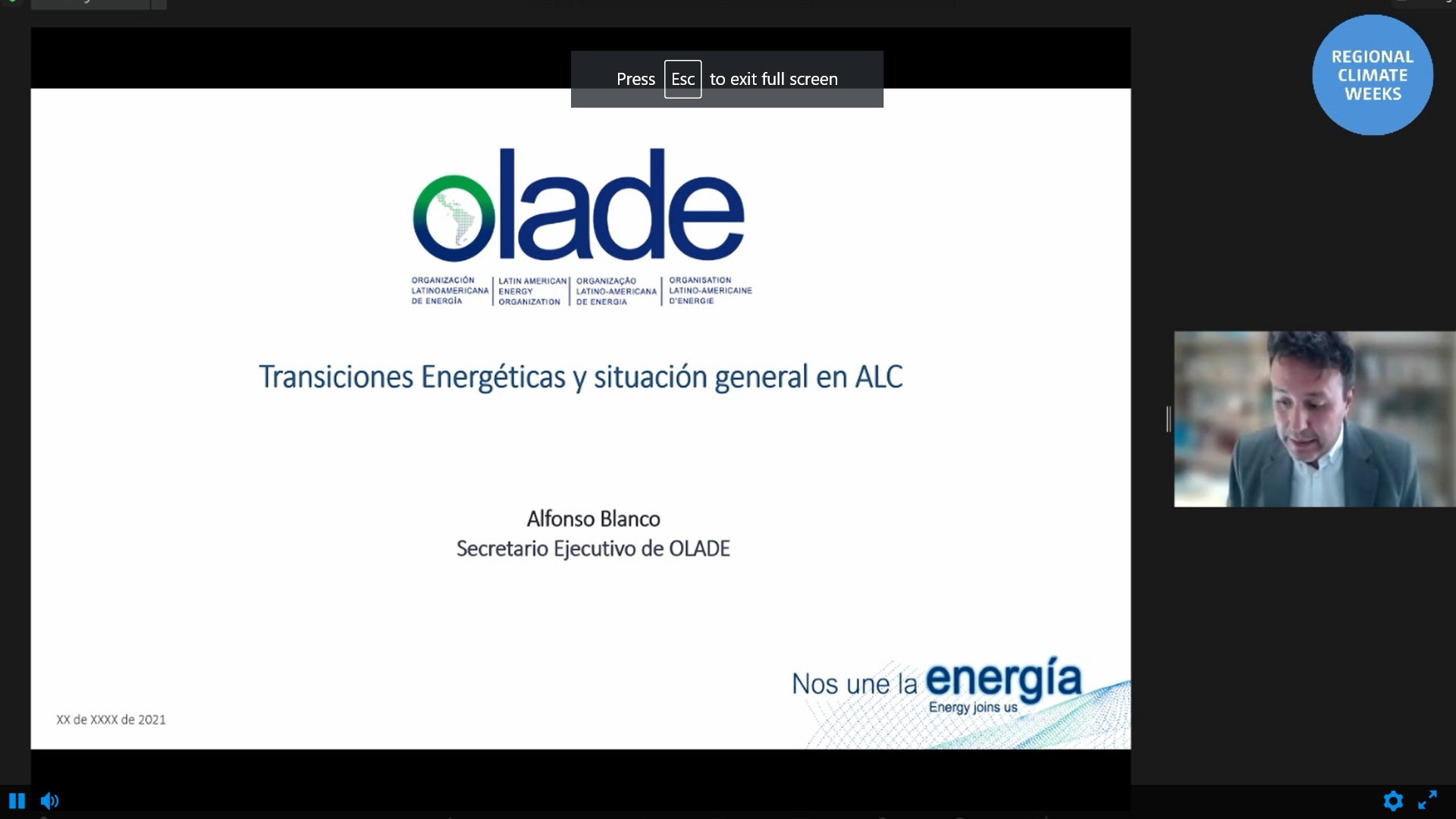
During the Climate Week of Latin America and the Caribbean 2021, the Executive Secretary of OLACDE presented the LAC strategy for the Energy Transition

This year the Climate Week of Latin America and the Caribbean (LAC) 2021 took place virtually from May 11 to 14. This event is the preamble to the United Nations Climate Change Conference 2021 (COP26) to be held in Glasgow (United Kingdom) in November.


In the framework of the Climate Week of Latin America and the Caribbean 2021, the Executive Secretary of The Latin American and Caribbean Energy Organization (OLACDE), Alfonso Blanco, presented the topic: LAC Strategy for the Energy Transition, during the session Policies for behavior change and technological development.


“The energy transition is not a one-dimensional issue of infrastructure change, it must be supported by a national commitment and must be developed in parallel with actions aimed at increasing the participation of renewable energies in the energy matrix and policies that reduce energy consumption and promote energy efficiency in all consumer sectors”, stated the Executive Secretary, Alfonso Blanco.


Additionally, he mentioned that “the speed of the transition will depend strongly on the factor endowment of the economy in question. Thus, economies rich in capital and with few natural resources of fossil origin will advance faster in their transition than economies with fewer capital resources or those that still possess huge energy resources of fossil origin such as coal, oil or natural gas”.


Part of his intervention was aimed at explaining that energy poverty can be presented through the Human Development Index (HDI), compared with the residential consumption of electricity per capita, to which he mentioned that “it is clear that higher levels of household consumption correspond to a higher level of human development. In Latin America and the Caribbean, around 20 million people lack access to electricity”.


Currently, in the region more than 97% of the population has access to electricity and other modern energies. In clean cooking the number is around 86%.


In his speech, the Executive Secretary of OLACDE also reported that “in September 2019, Colombia led the RELAC regional initiative, the objective of which is to increase the participation of renewable energies in the electricity generation matrix to achieve a goal of 70% by 2030 “.


“The region has more than 25% renewable energy as primary energy, it is the highest percentage in the energy matrix compared to the rest of the world.”


During the Climate Week, the actions that each Latin American country is taking to combat global warming and strategies to be resilient to climate change were discussed. This year the Climate Week had the Government of the Dominican Republic as host.
Share this news

During the Climate Week of Latin America and the Caribbean 2021, the Executive Secretary of OLACDE presented the LAC strategy for the Energy Transition

Newsletter summary

This year the Climate Week of Latin America and the Caribbean (LAC) 2021 took place virtually from May 11 to 14. This event is the preamble to the United Nations Climate Change Conference 2021 (COP26) to be held in Glasgow (United Kingdom) in November.

Knowledge and Training

We promote advanced technical training programs that facilitate the exchange of experiences, as well as the development of the human and institutional capacities needed to support the energy transformations in our region.

Our academic offering includes executive programs, postgraduate diplomas, master’s degrees, and innovative initiatives focused on topics such as energy transition, conventional energy, renewable energy, e-mobility, and regional integration.

OLACDE creates a regional network focused on energy knowledge that connects governments, young professionals, academics, and sector experts to drive collaborative solutions through technical cooperation and talent development to address future energy and climate challenges.

Technical cooperation and financing

We strengthen South-South and triangular cooperation ties as drivers to accelerate energy transitions in Latin America and the Caribbean. OLACDE brings together efforts among governments, multilateral organizations, academic institutions, and the private sector to mobilize financing, technical capacities, and innovative solutions tailored to our regional reality.

We promote strategic initiatives aimed at directing resources toward projects focused on decarbonization, conventional energy, renewable energy, and energy justice, with the objective of establishing a more efficient, inclusive, and sustainable regional cooperation architecture.

Regional Energy Community

We are building a regional energy community with a global outlook that seeks to position Latin America and the Caribbean as a key player on the international stage. OLACDE strengthens its representation in major multilateral forums related to energy, trade, and climate by fostering strategic alliances and promoting international cooperation.

Through events such as Energy Week, together with new spaces for international dialogue, we promote a collective voice that helps attract financial investment and create new opportunities for sustainable development across our region.

Energy Transition and Strategic Projects

We drive an energy transition based on principles of sustainability, energy security, and social inclusion. OLACDE supports countries in adopting new technologies related to energy efficiency, energy storage, green hydrogen, electromobility, and grid digitalization to accelerate the sector’s decarbonization process.

Our approach also includes promoting strategic projects that strengthen energy resilience at the regional level, contributing to emission reductions while consolidating a cleaner and more competitive energy infrastructure. Initiatives such as OEMLAC position our region as a leading reference in climate innovation and sustainable energy transition.

Energy information and data

We develop regional platforms dedicated to energy information, technical analysis, and strategic data systems that strengthen both public and private decision-making in the sector. OLACDE promotes the digital transformation of the sector through the use of artificial intelligence, georeferencing, and advanced tools for regional energy analysis.

The integration of systems such as SieLAC, together with new regional platforms, allows for the consolidation of reliable and up-to-date technical information, facilitating modern, interoperable, and evidence-based energy planning.

Regional Energy Integration

We promote cooperation in the regional energy sector, focused on collaboration, infrastructure development, and regulatory harmonization, with the objective of strengthening energy security in Latin America and the Caribbean. OLACDE coordinates projects related to electrical interconnection, gas integration, and regional energy planning, seeking to create efficient and sustainable partnerships.

Through cooperation with the governments of our 27 member countries, regional blocs, multilateral institutions, and both public and private stakeholders, we drive strategic initiatives that promote regulatory harmonization and new energy exchange mechanisms, in order to enhance national capacities and accelerate an integrated energy transition at the regional level.

This site is registered on wpml.org as a development site. Switch to a production site key to remove this banner.