Evaluation of the Sustainable Energy Access for the Latin America and the Caribbean (LAC) Region Project

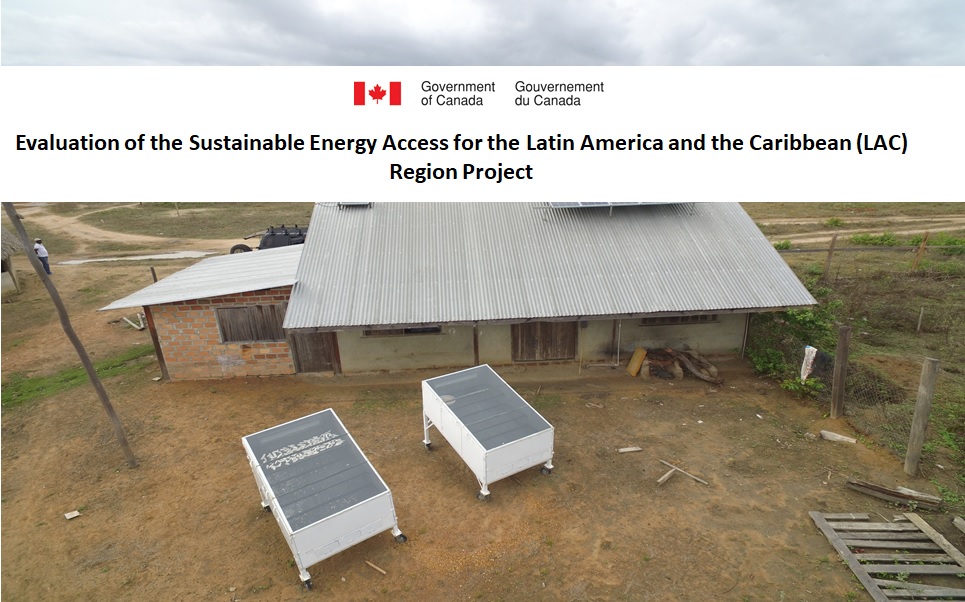
The Inter-American Affairs Division, Global Affairs Canada commissioned a consultancy group to elaborate a summative evaluation of the project: “Sustainable Energy Access for the Latin America and Caribbean Region” (SEALAC). This Project was implemented by The Latin American and Caribbean Energy Organization (OLACDE) in 14 countries from LAC region (Belize, Bolivia, Colombia, Cuba, Dominican Republic, Grenada, Guatemala, Guyana, Haiti, Honduras, Jamaica, Nicaragua, Peru and Surinam), using financial resources of the Canadian Government in the amount of $9.2 million of Canadian dollars. The specific objectives of the evaluation were the following: a) assess the effectiveness and efficiency of OLACDE; b) assess sustainability/relevance of results, including women and Indigenous people; and, c) generate findings, conclusions, recommendations and lessons to guide the design of future programming in the Latin American and Caribbean energy sector in accordance with the GAC quality standards. The consultancy team adopted an evaluation methodology which utilizes mixed approaches combining analysis of qualitative and quantitative data. It included document review, semi-structured interviews and focus groups with key stakeholders in five countries, on-line surveys of participants in capacity building, and data collection and analysis. The main conclusions of the evaluation are as follows:
  • The capacity building under SEALAC through CAPEV Program and face to face training has been effective despite high staff turnover in the ministries and other stakeholders. Evidence of this is obtained by the semi-structured interviews and focus groups conducted by the Evaluation Team in five of the beneficiary countries. The online survey provides quantitative statistical confirmation of this result.
  • Efforts to support energy policy development at the national and regional level have encountered difficulties due to lack of political ownership by the governments which have been compounded by tensions in the region. The field missions confirmed the reporting of the project that the technical assistance had been mobilized. The development of the energy policy was not achieved fully in Grenada, or Bolivia according to the field missions. However, the Evaluation field missions found that there had been progress in energy policy development in Dominican Republic and Honduras.
  • Although some progress has been made, Gender remains a key issue in the Energy Sector in the Region. In particular, the Evaluation field missions in Bolivia and Honduras found that pressures to respect community traditions and social norms tended to limit the role of women in decision making.
  • Corporative Social Responsibility (CSR) still offers benefits to the region despite challenges with implementation and limited progress on community dialogue. The field missions in Bolivia, Dominican Republic and Honduras found that while the companies acquired skills and knowledge from the CSR training, not as much cohesion and dialogue with communities was achieved as could have been expected. CSR training needs to stress community outreach and dialogue with more interaction among stakeholder groups.
The findings, conclusions, recommendations and lessons listed are those of the consultant and do not necessarily reflect the views of GAC or the Government of Canada. GAC does not guarantee the accuracy of the information provided in this report. Whole Summary Paper
Share this news

Evaluation of the Sustainable Energy Access for the Latin America and the Caribbean (LAC) Region Project

Newsletter summary

The Inter-American Affairs Division, Global Affairs Canada commissioned a consultancy group to elaborate a summative evaluation of the project: “Sustainable Energy Access for the Latin America and Caribbean Region” (SEALAC).

Knowledge and Training

We promote advanced technical training programs that facilitate the exchange of experiences, as well as the development of the human and institutional capacities needed to support the energy transformations in our region.

Our academic offering includes executive programs, postgraduate diplomas, master’s degrees, and innovative initiatives focused on topics such as energy transition, conventional energy, renewable energy, e-mobility, and regional integration.

OLACDE creates a regional network focused on energy knowledge that connects governments, young professionals, academics, and sector experts to drive collaborative solutions through technical cooperation and talent development to address future energy and climate challenges.

Technical cooperation and financing

We strengthen South-South and triangular cooperation ties as drivers to accelerate energy transitions in Latin America and the Caribbean. OLACDE brings together efforts among governments, multilateral organizations, academic institutions, and the private sector to mobilize financing, technical capacities, and innovative solutions tailored to our regional reality.

We promote strategic initiatives aimed at directing resources toward projects focused on decarbonization, conventional energy, renewable energy, and energy justice, with the objective of establishing a more efficient, inclusive, and sustainable regional cooperation architecture.

Regional Energy Community

We are building a regional energy community with a global outlook that seeks to position Latin America and the Caribbean as a key player on the international stage. OLACDE strengthens its representation in major multilateral forums related to energy, trade, and climate by fostering strategic alliances and promoting international cooperation.

Through events such as Energy Week, together with new spaces for international dialogue, we promote a collective voice that helps attract financial investment and create new opportunities for sustainable development across our region.

Energy Transition and Strategic Projects

We drive an energy transition based on principles of sustainability, energy security, and social inclusion. OLACDE supports countries in adopting new technologies related to energy efficiency, energy storage, green hydrogen, electromobility, and grid digitalization to accelerate the sector’s decarbonization process.

Our approach also includes promoting strategic projects that strengthen energy resilience at the regional level, contributing to emission reductions while consolidating a cleaner and more competitive energy infrastructure. Initiatives such as OEMLAC position our region as a leading reference in climate innovation and sustainable energy transition.

Energy information and data

We develop regional platforms dedicated to energy information, technical analysis, and strategic data systems that strengthen both public and private decision-making in the sector. OLACDE promotes the digital transformation of the sector through the use of artificial intelligence, georeferencing, and advanced tools for regional energy analysis.

The integration of systems such as SieLAC, together with new regional platforms, allows for the consolidation of reliable and up-to-date technical information, facilitating modern, interoperable, and evidence-based energy planning.

Regional Energy Integration

We promote cooperation in the regional energy sector, focused on collaboration, infrastructure development, and regulatory harmonization, with the objective of strengthening energy security in Latin America and the Caribbean. OLACDE coordinates projects related to electrical interconnection, gas integration, and regional energy planning, seeking to create efficient and sustainable partnerships.

Through cooperation with the governments of our 27 member countries, regional blocs, multilateral institutions, and both public and private stakeholders, we drive strategic initiatives that promote regulatory harmonization and new energy exchange mechanisms, in order to enhance national capacities and accelerate an integrated energy transition at the regional level.

This site is registered on wpml.org as a development site. Switch to a production site key to remove this banner.