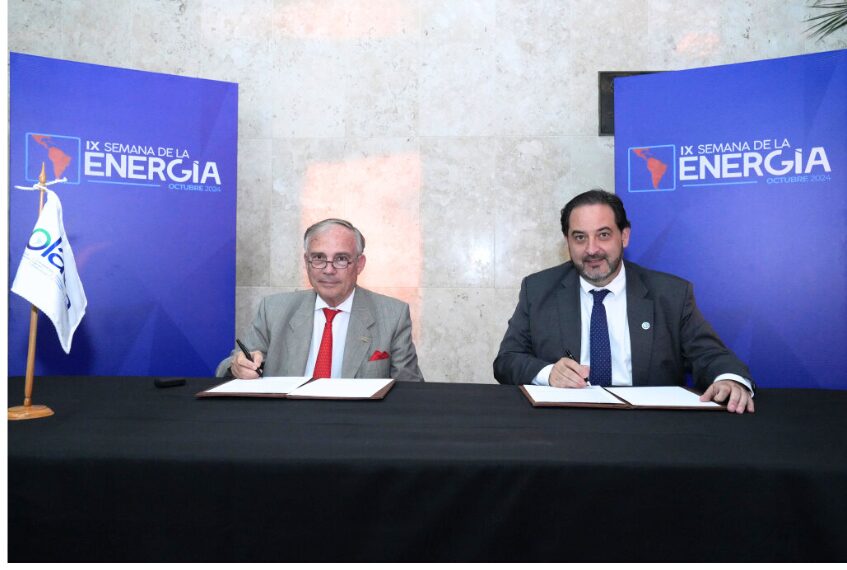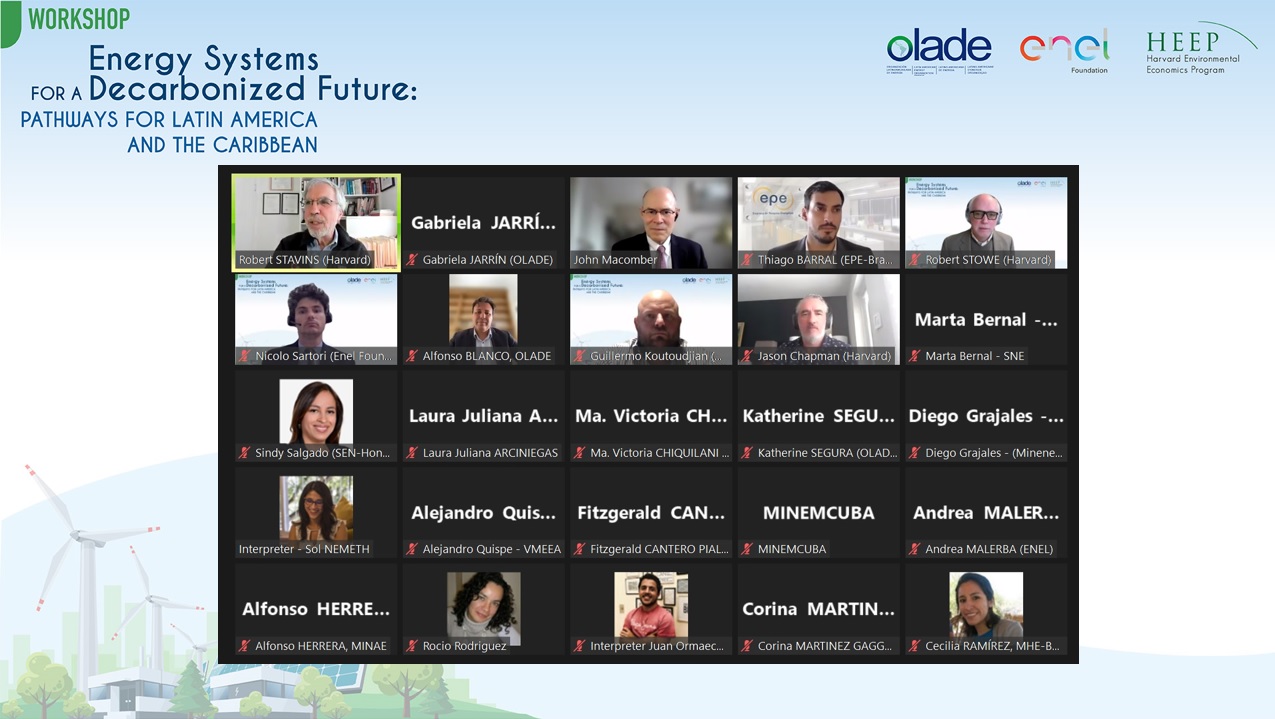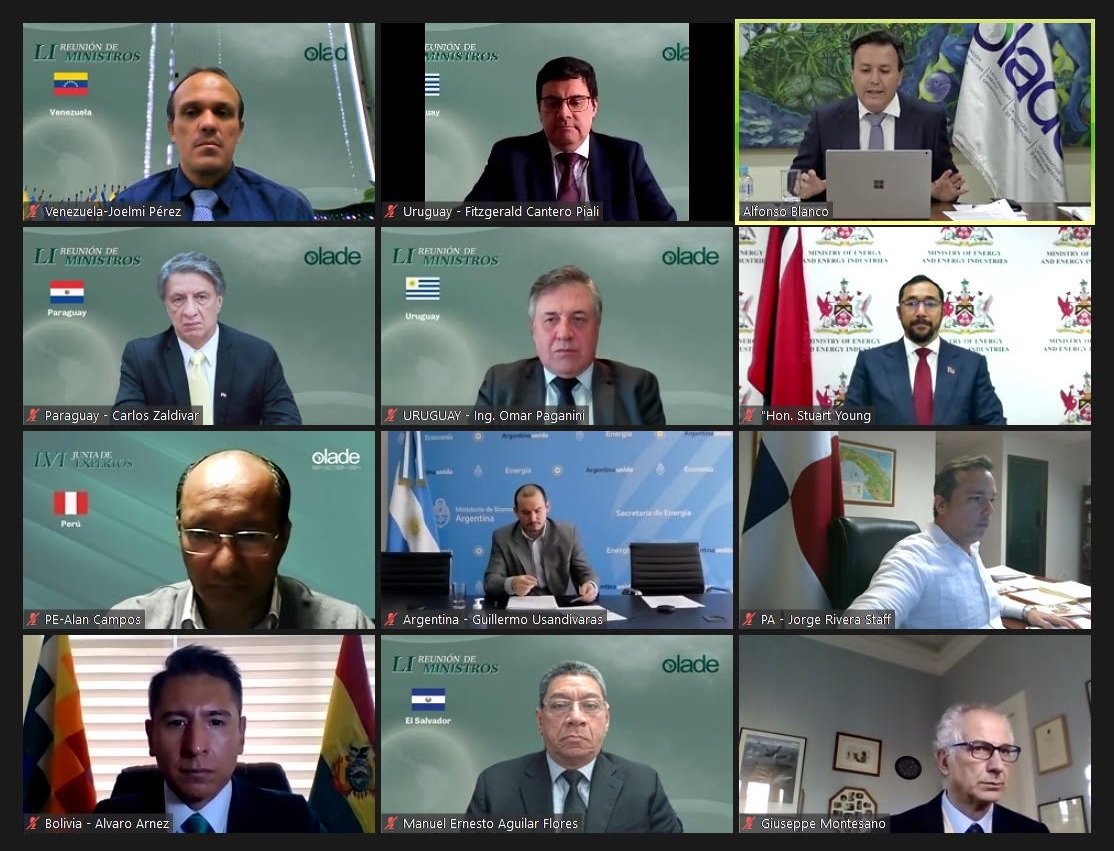
Representatives and delegations of the Member Countries of The Latin American and Caribbean Energy Organization (OLACDE) in the LI Meeting of Ministers, which was held in virtual modality, on Wednesday, November 24, 2021 within the framework of the VI Energy Week, discussed the following central issues: agendas for the decarbonization of the energy sector, facilitate strategies for the development of hydrogen as an energy vector and recognize gas as a transition fuel in some countries of the region, if its development is guaranteed in a sustainable manner.
The opening of the inaugural session was attended by the Minister of Energy and Energy Industries of the Republic of Trinidad and Tobago, Stuart Young; the incoming president of the LI Meeting of Ministers of OLACDE, the Minister of Industry, Energy and Mining of the Oriental Republic of Uruguay, Omar Paganini; and OLACDE’s Executive Secretary, Alfonso Blanco.
The Minister of Energy and Energy Industries of the Republic of Trinidad and Tobago, Stuart Young, mentioned that ¨the Member Countries continue to be 100% committed to cooperation for energy security and sustainability in the region. In Trinidad and Tobago’s experience, taking OLACDE’s presidency has been very fruitful and positive, even in this very complicated pandemic.”
¨ During our work, Trinidad and Tobago is proud to vindicate its commitment as a member of OLACDE and continues to have the greatest honor of participating in this organization.¨
As part of the agenda of the Meeting of Ministers, the Minister of Trinidad and Tobago, Stuart Young, handed over the Presidency of the meeting to the Minister of Industry, Energy and Mining of the Oriental Republic of Uruguay, Omar Paganini.
For his part, Minister Paganini, thanked the Minister of the Republic of Trinidad and Tobago, Stuart Young “for the work carried out during his presidency to promote OLACDE’s agenda and his future support in the next stage.”
¨Our country has experienced in the last decade a true energy revolution with an average participation of 97% of renewable energies in electricity generation, including hydro, wind, biomass and solar, in the last 4 years until 2020, ¨ he reported.
In this sense, he reaffirmed their commitment to decarbonization and regional energy integration and mentioned the need to move towards electric mobility and green hydrogen.
The Executive Secretary of OLACDE in his speech paid tribute to the Minister of Energy and Energy Industries of the Republic of Trinidad and Tobago for the period 2020, Franklin Khan, who was president of the meeting of Ministers of OLACDE during the beginning of 2021, and reiterated the condolences to the country for his sensitive death.
He welcomed the incoming president of the LI Meeting of Ministers, Minister Paganini and the Vice Presidency in charge of Argentina, headed by Secretary of Energy Norman Darío Martínez, for being part of the Organization’s Governance Body and expressed the total commitment of this executive secretariat to continue working on strengthening regional integration dialogue platforms and responding to the needs and vision of the new governing body.
Ministerial Declaration
Unanimously, the representatives of 21 OLACDE Member Countries approved a new proposal for a Ministerial Declaration, which ratifies the commitment to accelerate energy transitions towards cleaner and lower-carbon systems.
Among the priority points of the agreement, it stands out to assume that each country will have its own path for the decarbonization of its energy systems, but that among the technologies that stimulate the transition are those that are renewables, and recognizing the possibility that some countries may choose to sustainable natural gas developments, and, in other cases, carbon capture and storage alternatives (see Ministerial Declaration).
Among the items agreed upon, the Ministers declared as a priority to increase the efforts to allow access to efficient financing mechanisms for the incorporation of clean technologies, with special consideration to improve the conditions of countries with unstable macroeconomic frameworks and lower relative development in order to reduce gaps in access to financing in our region.
Keynote Speeches
The opening session of the LI Meeting of Ministers of OLACDE featured keynote speeches by: the executive secretary of the United Nations Framework Convention on Climate Change (UNFCCC), Patricia Espinosa, who highlighted that ¨the energy sector will play a leading role in this transformation and it is not an exaggeration to say that energy is at the center of the climate change emergency and must be at the center of its solution.”
In addition, she emphasized that, if the objectives of the Paris agreement are to be met, nations must commit to a deep and lasting transformation on “how to create, use and distribute energy, through a path of decarbonization.”
The director general of the International Renewable Energy Agency (IRENA), Francesco La Camera in his speech: ¨IRENA is committed to supporting countries on the path to 1.5 degrees, positioning renewable energies at the center of global climate action.¨
In her speech, the Deputy Executive Director of the International Energy Agency, Mary Bruce Warlick, mentioned that the Agency is “pleased to work with countries in the region to identify policies and technologies that reduce emissions from the energy sector and help us to reach decarbonization¨.
For his part, the Manager of the Infrastructure and Energy Sector of the Inter-American Development Bank, Ariel Yépez, reported that the IDB has defined 5 priority areas as part of its 2025 vision: (1) regional integration; (2) support for small and medium enterprises; (3) digital transformation; (4) gender equality; and (5) response to climate change.
¨The energy transition is a key point of Vision 2025, since it touches several of its priority areas, through a sustainable and inclusive economic and social development.¨
Ministerial Dialogue
As is customary at the OLACDE Meeting of Ministers, the Ministerial Dialogue was held with the central theme related to the agendas for the decarbonization of the energy sector, where the high authorities of the sector participated in national actions and future prospects.
“We heard from Colombia how these transformations can be slow until they are not and can jump from low levels of renewables to very high percentages in a matter of years,” said Marcelino Madrigal, the IDB’s principal energy specialist.
Regarding this issue, Julián Rojas, head of the Office of Regulatory and Business Affairs of the Ministry of Mines and Energy, said that it is urgent “to make decisions drastically and effectively in policies aligned with the Paris Agreement.”
The summary of ministerial presentations raised by Marcelino Madrigal, highlighted ¨ the need for greater diversification of energy matrices, based on clean, non-polluting sources to provide greater resilience to local electrical systems.¨
“We hear from all the ministers a clarity that this transition has to be orderly and we cannot leave anyone behind.”
“In the electricity sector we are fortunate in natural resources that have allowed us to maintain high percentages of renewables. However, climate change is generating impacts on this same source and we hear from Brazil the need to continue maintaining a high level of renewables, integrating greater diversification from other sources to offset the impacts.”
In this regard, the Minister of Mines and Energy of Brazil, Bento Albuquerque Lima Júnior, pointed out: “In the Brazilian case, when we talk about decarbonization of the energy sector, we are referring to the extraordinary challenge of maintaining and diversifying the participation of renewable sources or of low emissions in a very clean and renewable matrix.”
Each country contributed new issues to be addressed in the short and medium term. In the case of Argentina, the Secretary of Energy of the Nation, Darío Martínez, stressed the need that the transition should be fair, economically sustainable and understood from the local needs while respecting sovereignty.
Full opening session LI Ministers Meeting