The post-pandemic scenario could open space for business models supported by renewable energies

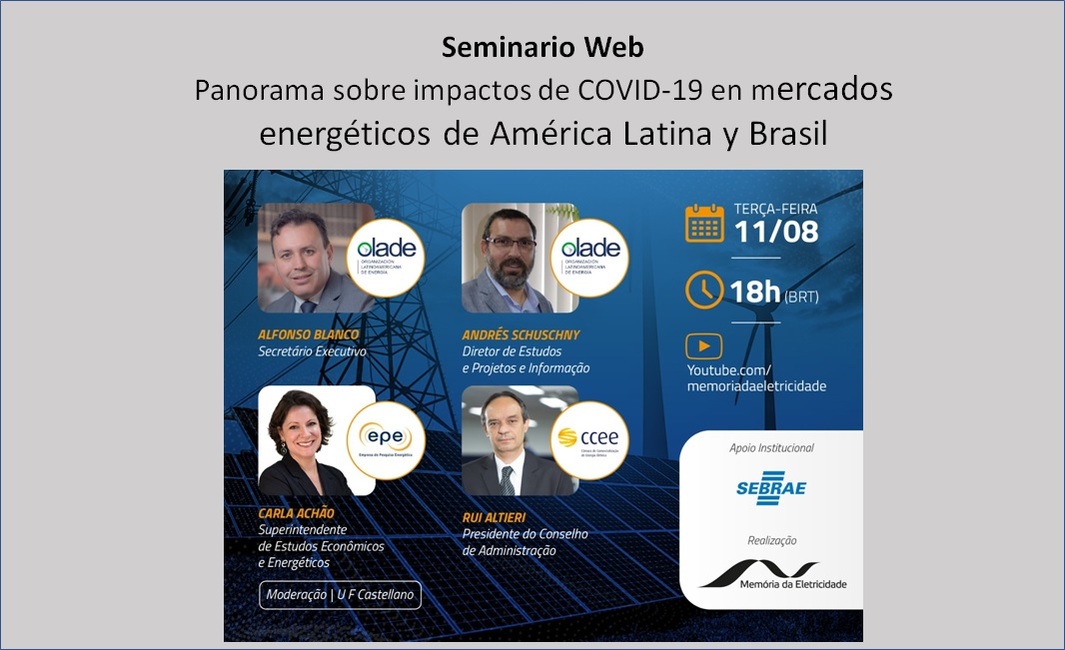
The Web Seminar “Outlook on the impacts of COVID-19 in energy markets in Latin America and Brazil”, promoted by Memória da Eletricidade with the collaboration of the Sustainable Campus – Unicamp project and the support of Sebrae, held on August 11, 2020, featured with a massive virtual call from the energy sector community in the region. Space where The Latin American and Caribbean Energy Organization (OLACDE) participated in conjunction with the Empresa de Pesquisa Energética (EPE) and the Câmara de Comercialização de Energia Elétrica (CCEE).

The Executive Secretary of OLACDE, Alfonso Blanco, in his presentation on the outlook of the impacts of COVID-19 in the energy sector of Latin America and the Caribbean, explained that “the post-pandemic scenario is going to have an even greater impact on the economies of countries that are oil exporters, since the regional oil-exporting economies, faced with a sharp drop in international demand, are also seeing their fiscal income reduced ”.

In this context, the Executive Secretary of OLACDE predicts that the economies of Latin America and the Caribbean will contract between 3% and 15%, as a consequence of the increase in the fiscal deficit, which has been generated by a fall in tax collection and an increase of public spending due to the pandemic.

On the other hand, he stated that this situation could open space for business models supported by renewable energies and could even be an opportunity to accelerate the energy transition, with the help of public policies that allow the creation of new associations that help to overcome the economic crisis and to accelerate the desired transition.

In this regard, he explained that the contraction in demand, which has a direct cause in the containment measures, impacts the commercial and services sector that are the most affected, but highlights that in parallel to this there was a change in consumption patterns. “Consumers adopted new consumption patterns in many things: telework is present, electric mobility may have a greater development as a result of this pandemic, aspects associated with smart grids, self-production of energy, distributed generation, are elements that we are going to have to keep in mind and that we are going to have to incorporate. We are facing a change of era ”.

In the intervention of the Director of Studies, Projects and Information of OLACDE, Andrés Schuschny, the disaggregated data of several countries in the region was presented and the drop in production was analyzed. He reported that a decrease of between 6% and 32% was evidenced in the demand for electricity in the countries of Latin America and the Caribbean with respect to the situation prior to social isolation by COVID-19.

The Director of Studies, Projects and Information of OLACDE, pointed out that Peru suffered the greatest drop in demand, reaching a reduction of almost 36%, followed by Bolivia with 29%, Argentina with 26%, Colombia and Ecuador 16%, Panama 15 %, Uruguay 14% and Chile 6%.

To this, he added that the generation of hydroelectric energy was favored because many thermal plants had to be shut down due to this decrease and pointed out as an example the case of Peru, where the production of electrical energy on average fell 32% since the declaration of quarantine of the March 15, 2020, while there was a significant reduction in the contribution of natural gas to the energy matrix, going from 25% to 5% on average and currently hydraulic energy reaches close to 90% participation.

For her part, EPE’s Superintendent of Economic and Energy Studies, Carla Achão, conducted an in-depth analysis of energy demand in Brazil, highlighting not only the impacts of COVID-19 on energy consumption, but also the vision of the EPE on market prospects. Despite the slight recovery in June, Carla Achão pointed out that the negative result expected for 2020 represents a continuation of the trajectory of the crisis and the low growth that has occurred since 2015.

Rui Altieri, Chairman of the CCEE Board of Directors, presented the impacts of the pandemic on electricity consumption, pointing to a greater drop for the month of April, reaching 12.1%. It also showed a gradual and more positive resumption starting in May. Furthermore, compared to the period when social isolation began, Rui Altieri showed that the impact of the crisis was less intense in the free market than in the regulated market.


Communication Department
and Institutional Relations

gabriela.jarrin@OLACDE.org
Share this news

The post-pandemic scenario could open space for business models supported by renewable energies

Newsletter summary

The Web Seminar “Outlook on the impacts of COVID-19 in energy markets in Latin America and Brazil”, promoted by Memória da Eletricidade with the collaboration of the Sustainable Campus – Unicamp project and the support of Sebrae, held on August 11, 2020, featured with a massive virtual call from the energy sector community in the region. Space where The Latin American and Caribbean Energy Organization (OLACDE) participated in conjunction with the Empresa de Pesquisa Energética (EPE) and the Câmara de Comercialização de Energia Elétrica (CCEE). The Executive Secretary of OLACDE, Alfonso Blanco, in his presentation on the outlook of the impacts of COVID-19 in the energy sector of Latin America and the Caribbean, explained that “the post-pandemic scenario is going to have an even greater impact on the economies of countries that are oil exporters, since the regional oil-exporting economies, faced with a sharp drop in international demand, are also seeing their fiscal income reduced ”. In this context, the Executive Secretary of OLACDE predicts that the economies of Latin America and the Caribbean will contract between 3% and 15%, as a consequence of the increase in the fiscal deficit, which has been generated by a fall in tax collection and an increase of public spending due to the pandemic. On the other hand, he stated that this situation could open space for business models supported by renewable energies and could even be an opportunity to accelerate the energy transition, with the help of public policies that allow the creation of new associations that help to overcome the economic crisis and to accelerate the desired transition. In this regard, he explained that the contraction in demand, which has a direct cause in the containment measures, impacts the commercial and services sector that are the most affected, but highlights that in parallel to this there was a change in consumption patterns. “Consumers adopted new consumption patterns in many things: telework is present, electric mobility may have a greater development as a result of this pandemic, aspects associated with smart grids, self-production of energy, distributed generation, are elements that we are going to have to keep in mind and that we are going to have to incorporate. We are facing a change of era ”. In the intervention of the Director of Studies, Projects and Information of OLACDE, Andrés Schuschny, the disaggregated data of several countries in the region was presented and the drop in production was analyzed. He reported that a decrease of between 6% and 32% was evidenced in the demand for electricity in the countries of Latin America and the Caribbean with respect to the situation prior to social isolation by COVID-19. The Director of Studies, Projects and Information of OLACDE, pointed out that Peru suffered the greatest drop in demand, reaching a reduction of almost 36%, followed by Bolivia with 29%, Argentina with 26%, Colombia and Ecuador 16%, Panama 15 %, Uruguay 14% and Chile 6%. To this, he added that the generation of hydroelectric energy was favored

Knowledge and Training

We promote advanced technical training programs that facilitate the exchange of experiences, as well as the development of the human and institutional capacities needed to support the energy transformations in our region.

Our academic offering includes executive programs, postgraduate diplomas, master’s degrees, and innovative initiatives focused on topics such as energy transition, conventional energy, renewable energy, e-mobility, and regional integration.

OLACDE creates a regional network focused on energy knowledge that connects governments, young professionals, academics, and sector experts to drive collaborative solutions through technical cooperation and talent development to address future energy and climate challenges.

Technical cooperation and financing

We strengthen South-South and triangular cooperation ties as drivers to accelerate energy transitions in Latin America and the Caribbean. OLACDE brings together efforts among governments, multilateral organizations, academic institutions, and the private sector to mobilize financing, technical capacities, and innovative solutions tailored to our regional reality.

We promote strategic initiatives aimed at directing resources toward projects focused on decarbonization, conventional energy, renewable energy, and energy justice, with the objective of establishing a more efficient, inclusive, and sustainable regional cooperation architecture.

Regional Energy Community

We are building a regional energy community with a global outlook that seeks to position Latin America and the Caribbean as a key player on the international stage. OLACDE strengthens its representation in major multilateral forums related to energy, trade, and climate by fostering strategic alliances and promoting international cooperation.

Through events such as Energy Week, together with new spaces for international dialogue, we promote a collective voice that helps attract financial investment and create new opportunities for sustainable development across our region.

Energy Transition and Strategic Projects

We drive an energy transition based on principles of sustainability, energy security, and social inclusion. OLACDE supports countries in adopting new technologies related to energy efficiency, energy storage, green hydrogen, electromobility, and grid digitalization to accelerate the sector’s decarbonization process.

Our approach also includes promoting strategic projects that strengthen energy resilience at the regional level, contributing to emission reductions while consolidating a cleaner and more competitive energy infrastructure. Initiatives such as OEMLAC position our region as a leading reference in climate innovation and sustainable energy transition.

Energy information and data

We develop regional platforms dedicated to energy information, technical analysis, and strategic data systems that strengthen both public and private decision-making in the sector. OLACDE promotes the digital transformation of the sector through the use of artificial intelligence, georeferencing, and advanced tools for regional energy analysis.

The integration of systems such as SieLAC, together with new regional platforms, allows for the consolidation of reliable and up-to-date technical information, facilitating modern, interoperable, and evidence-based energy planning.

Regional Energy Integration

We promote cooperation in the regional energy sector, focused on collaboration, infrastructure development, and regulatory harmonization, with the objective of strengthening energy security in Latin America and the Caribbean. OLACDE coordinates projects related to electrical interconnection, gas integration, and regional energy planning, seeking to create efficient and sustainable partnerships.

Through cooperation with the governments of our 27 member countries, regional blocs, multilateral institutions, and both public and private stakeholders, we drive strategic initiatives that promote regulatory harmonization and new energy exchange mechanisms, in order to enhance national capacities and accelerate an integrated energy transition at the regional level.

This site is registered on wpml.org as a development site. Switch to a production site key to remove this banner.